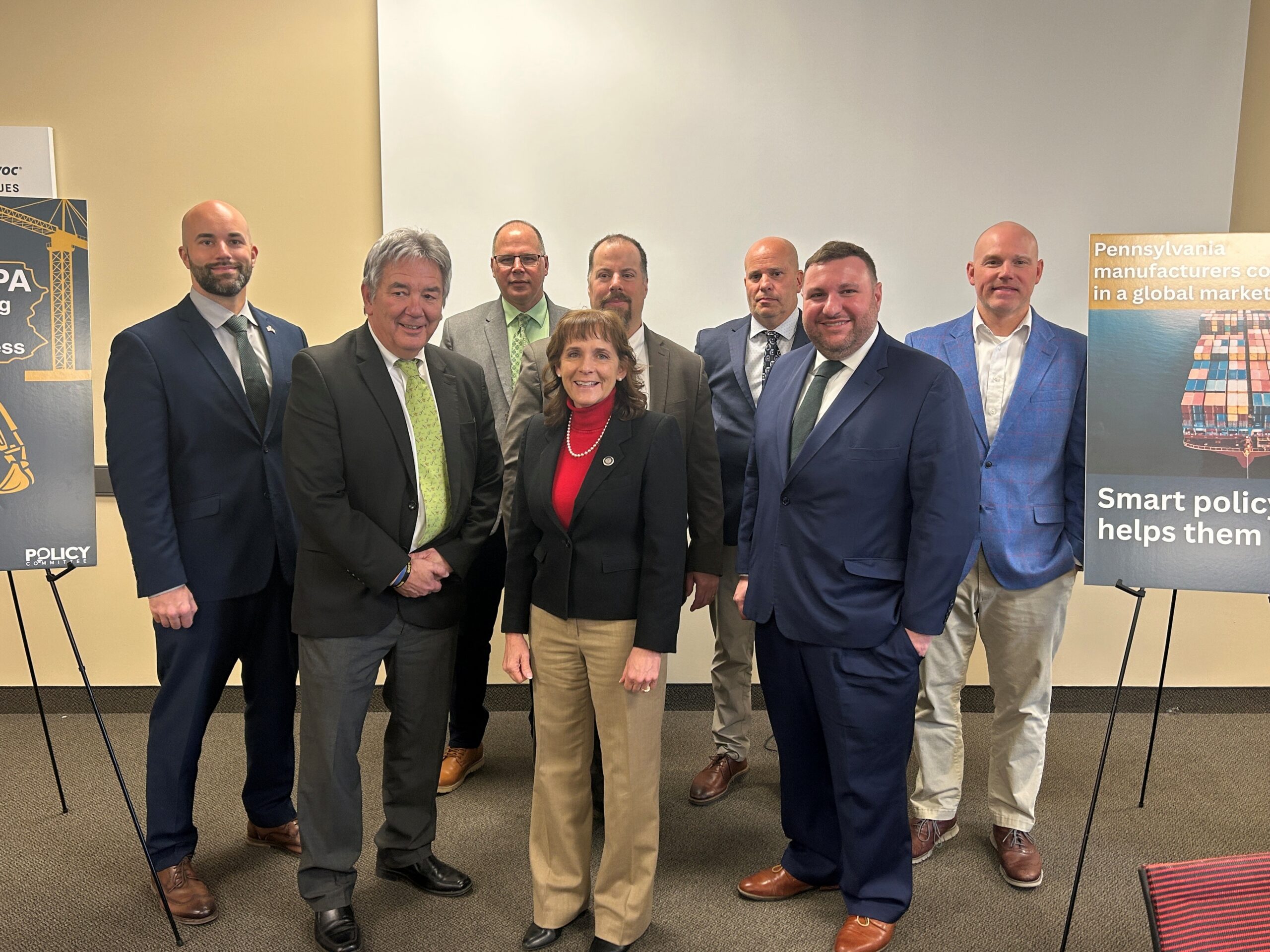
On Tuesday, March 17, FCADC President Mike Ross was invited by State Representative Chad Reichard (PA-90) to provide testimony before the Pennsylvania House of Representatives Policy Committee. The hearing, titled “Built in
Pennsylvania: Strengthening Industrial Competitiveness,” was held at Manitowoc Crane Group’s facility in Shady Grove. The discussion centered on how Pennsylvania’s regulatory environment, energy policies, and infrastructure
investments can better support manufacturing employers and enhance the Commonwealth’s overall industrial competitiveness. Ross joined a panel of industry leaders that included Mike Reed, Vice President and General Manager of North America operations for Manitowoc Cranes, and Gustavo Casagrandi, General Manager of Volvo Construction Equipment. In addition to the hearing, attendees participated in a tour of Manitowoc’s production facilities, highlighting the region’s advanced manufacturing capabilities.
Below is the text of Ross’ testimony…
Making Pennsylvania More Competitive
(Unlocking Pennsylvania’s Future)
PA House of Representatives
Policy Committee Hearing
March 17, 2026
Manitowoc Crane Group, Shady Grove, PA
Good morning. My name is Mike Ross, and I am president of the Franklin County Area Development Corporation. I extend my thanks to the committee, and especially representative Reichard, for the opportunity to share my thoughts to unlock the Commonwealth’s future by making us more competitive. As a county that regularly competes with three other states, I am highly sensitive to issues that impact community and economic development.
Unlocking Pennsylvania’s Future requires a practical competitiveness agenda: make it faster and more predictable to invest here, modernize the systems that move people and products, and align training with the jobs employers are actually trying to fill. Pennsylvania’s geography, industrial base, and research assets are major advantages—but other states win projects by reducing friction. The next decade should be defined by a clear commitment to speed, reliability, and workforce readiness.
1) Regulatory reform: move from “time-to-permit” to “time-to-build”
Pennsylvania can protect public health and the environment while also making decisions faster and more consistently. The biggest complaint from employers and site selectors is rarely “the standards are too high”—it’s that approvals are uncertain, sequential, and slow. The Commonwealth should pursue a Performance-Based Permitting approach built on five pillars:
- A statewide project “fast track” with real accountability.
The Commonwealth has already created a project-based streamlining approach through the PA Permit Fast Track Program, designed to improve coordination, predictability, and transparency for complex, high-impact infrastructure and economic development projects that require multiple state authorizations.
To maximize impact, Pennsylvania should scale Fast Track with clear eligibility, defined timelines, and public status updates—so businesses and communities can see progress, not just promises. The program guidance emphasizes coordination, predictability, and transparency; those should become measurable service standards across participating agencies. - Expand qualified third-party review where it reduces bottlenecks.
The Department of Environmental Protection’s SPEED Program (Streamlining Permits for Economic Expansion and Development), created in July 2024, allows applicants for select permits to use DEP-approved Qualified Professionals to conduct initial reviews, helping DEP focus staff time where it adds the most value and accelerating overall processing.
Pennsylvania should expand this model carefully (with strong ethics rules, auditing, and enforcement) to other technical reviews where professional certification already exists. The point is not to weaken oversight—it’s to increase throughput without sacrificing rigor. - Build “concurrent review” into law and practice.
Projects bog down when agencies review permits in a strict sequence, each waiting on the other. Pennsylvania should make concurrency the default: environmental, highway occupancy, utility coordination, and local land development approvals should proceed in parallel whenever legally feasible. When concurrency isn’t possible, agencies should publish clear dependency maps so applicants can plan. - Digital permitting and standardized completeness checks.
A modern, statewide digital permitting experience should include standard submittal requirements, “deemed complete” checklists, and real-time status dashboards. The objective is simple: reduce “surprise rework,” shorten cycles, and make outcomes more predictable for both applicants and the public. - Certainty for redevelopment and industrial reuse.
Pennsylvania should further streamline approvals for redevelopment of legacy industrial sites by providing coordinated permitting support, clear cleanup pathways, and predictable redevelopment standards. Competitive states win by turning “hard sites” into “ready sites.”
If Pennsylvania can reliably reduce the timeline from proposal to groundbreaking—without compromising standards—it will win more projects, especially in manufacturing, logistics, energy, and advanced materials.
2) Infrastructure investment: treat logistics reliability as a growth strategy
Infrastructure is economic development. When roads, bridges, and freight connectors are unreliable, employers bake delay and risk into their location decisions—and often choose somewhere else.
Pennsylvania should focus on three infrastructure priorities:
- Make I-81 a modern, resilient defense-and-freight corridor
A flagship investment should be widening and modernizing I-81, particularly in the south-central corridor where freight volumes, safety challenges, and congestion create high costs for carriers and employers. Regional partners and PennDOT have already advanced a coordinated strategy through the I-81 Improvement Strategy effort and its “playbook” approach for corridor investments.
In Franklin County, the MPO’s I-81 study process (launched in 2023 with FHWA and PennDOT participation) reflects the reality that needs outpace available revenue—making prioritization and sustained funding essential.
Just as importantly, I-81 should be treated as a National Defense–relevant corridor. The U.S. Strategic Highway Network, STRAHNET, is a national network of highways important for defense mobility and deployment; the USDOT BTS description underscores the defense-mobility purpose of this system.
Pennsylvania should explicitly align I-81 investments with defense mobility, resilience, and supply-chain continuity, strengthening the case for coordinated federal-state funding and ensuring the corridor can handle heavy, time-sensitive movement.
What “modernizing” I-81 should include:
- targeted widening where feasible and highest impact,
- interchange improvements that reduce weaving and crash risk,
- truck parking and safety upgrades,
- intelligent transportation systems (ITS) for incident response and reliability,
- bridge and pavement renewal designed for heavier freight demands.
The competitiveness payoff is real: safer, faster, more reliable movement for freight and commuters across south-central Pennsylvania—plus stronger readiness and redundancy for national mobility.
- Invest in freight as a system: highways, rail interfaces, and last-mile connectors
PennDOT’s Freight Movement Plan framework is explicitly designed to identify strategies, policies, and projects that improve multimodal freight movement and support competitiveness.
Pennsylvania should use freight planning to drive investment decisions that reduce delays, improve intermodal connectivity, and support industrial site readiness. That means not only major interstate corridors, but also:
- industrial access roads,
- rail spurs and grade crossing safety where they unlock capacity,
- port and terminal connectors,
- bottleneck interchanges near logistics clusters.
Freight is the bloodstream of Pennsylvania’s economy—from agriculture and food processing to advanced manufacturing and distribution. A statewide competitiveness agenda should treat freight upgrades as a top-tier growth lever, not a secondary planning exercise.
- Modernize utilities and broadband for “site readiness”
Communities compete on time and certainty. To expand “shovel-ready” inventory, Pennsylvania should coordinate infrastructure packages—road access, water/sewer capacity, power upgrades, and broadband—so sites can go from selection to operation quickly. Many projects fail or get delayed not because the business plan is weak, but because the supporting infrastructure is uncertain.
3) Workforce training: scale “earn-and-learn” and employer-driven skills development
Pennsylvania’s workforce challenge is not just a shortage—it’s a mismatch: employers need specific competencies, while too many training pathways aren’t tightly linked to hiring outcomes. The best competitiveness strategy is to align training dollars with placements and wage growth, while expanding pathways that let people learn while earning.
- Expand Registered Apprenticeship and pre-apprenticeship
Pennsylvania’s Apprenticeship & Training Office (ATO) describes its mission around expanding Registered Apprenticeship opportunities, including non-traditional occupations and underrepresented populations.
A competitiveness agenda should:
- expand apprenticeship in manufacturing, logistics, healthcare, and IT—not only the traditional trades,
- strengthen pre-apprenticeship pipelines through schools, CTCs, and community partners,
- simplify employer participation (paperwork and time burden are real barriers for small and mid-sized firms).
- Scale incumbent worker training tied to productivity
Pennsylvania already has a practical tool in WEDnetPA, which provides qualified employers training funds for new and existing employees.
This is exactly the kind of program that boosts competitiveness quickly: it helps firms upgrade skills, adopt new technologies, reduce turnover, and raise productivity. WEDnetPA guidelines emphasize strengthening the business environment by improving worker skills and productivity.
Pennsylvania should expand and modernize these supports, especially for small manufacturers and critical supply-chain employers—while tracking outcomes such as retention, wage gains, and promotion rates.
- Make community colleges and CTCs the “front door” to talent for employers
Training works best when employers co-design it. The Commonwealth should promote regional compacts that tie together:
- employers (who define skills and commit to hiring),
- community colleges/CTCs (who deliver training),
- workforce boards (who recruit and support participants),
- economic development organizations (who connect training to projects and site development).
The benchmark should be simple: are people getting hired into good jobs faster?
4) A competitiveness compact: faster delivery at the regional level
Finally, Pennsylvania should organize reforms and investments into a “competitiveness compact” that regions can execute. The formula:
- Permitting support (Fast Track + modernized agency processes),
- Infrastructure readiness (especially freight and site access),
- Workforce commitments (apprenticeships + incumbent training + rapid credentialing),
- Transparent metrics (time-to-permit, time-to-build, jobs created/retained, wages, private capital leveraged).
Pennsylvania wins when it becomes the easiest place in the Northeast to say “yes” quickly and responsibly—and then deliver projects on time.
Closing vision
Unlocking Pennsylvania’s future is not one big bill or one ribbon cutting. It’s a steady shift toward a state government that is faster, clearer, and more accountable—paired with infrastructure and workforce investments that lower the cost of doing business and raise the ceiling on growth. If we can streamline approvals through programs like Permit Fast Track and DEP SPEED, modernize freight corridors like I-81, align planning through PennDOT’s Freight Movement Plan, and scale proven workforce tools like WEDnetPA and Registered Apprenticeship, we will compete—and win—against any peer state for the next generation of jobs and investment.
Thank you for the opportunity to be here today.